Episode

What is Episode
Some experiences stay with us long after they happen.
They surface in memories, linger beneath conversations, and quietly shape the stories we tell ourselves and others.
Yet we often keep them in the background and struggle to find language that fully captures them.
Episode is where you will give words to your experiences and trace yourself through your own story.
Episode is a one-on-one writing process built around your lived experience.
We work with personal writing — stories from your life, memories, and reflections — to help explore meaningful experiences and find language for what they hold.
We work with personal writing — stories from your life, memories, and reflections — to help explore meaningful experiences and find language for what they hold.
Through close reading, detailed editorial response, thoughtful questions, and focused conversation, writing becomes a way of inquiry. Together, we follow where the writing leads, allowing it to uncover what lies beneath the surface of your story.
Through close reading, detailed editorial response, thoughtful questions, and focused conversation, writing becomes a way of inquiry. Together, we follow where the writing leads, allowing it to uncover what lies beneath the surface of your story.
You bring your lived stories.
I bring the lens and tools to help you write into them.
Together, we create the space your experience deserves.
Worth knowing
✦ This work lives alongside therapy, not inside it. The discoveries in this process emerge through writing, not through psychological treatment. Writing is the primary mode of exploration here.
✦ Your voice remains your own. I do not write for you. I help you write more deeply and more fully as yourself.
✦ You do not need a finished story or writing experience to begin. You can arrive with fragments, memories, questions, or a feeling you cannot yet name. The writing helps reveal what is already present, but not yet fully articulated.
Worth knowing
✦ This work lives alongside therapy, not inside it. The discoveries in this process emerge through writing, not through psychological treatment. Writing is the primary mode of exploration here.
✦ Your voice remains your own. I do not write for you. I help you write more deeply and more fully as yourself.
✦ You do not need a finished story or writing experience to begin. You can arrive with fragments, memories, questions, or a feeling you cannot yet name. The writing helps reveal what is already present, but not yet fully articulated.
How Episode Works
We start with a free 20-minute conversation to understand where you are, what you're working with, and what you need. From there, the process takes one of two shapes:
-
You already have writing you want to return to—a journal entry, personal essay, reflection, memory, or unfinished piece.
Together, we revisit it with careful attention, following what is emerging, what remains unresolved, and what the writing itself seems to be reaching toward.
After our introductory conversation, you send me your writing. I read it closely and return detailed comments and questions. We then meet for a first session to go deeper.
The session is a space for dialogue: we stay with what the text is reaching for, notice what it may be avoiding, and explore where it might want to continue developing.
With those insights, you return to your writing—revising, deepening, and extending the work. I read the new version, and we meet again for a second conversation.
Allow at least two sessions per written piece. For longer pieces (5+ pages), allow at least three.
﹡Sessions are held online or in person in Seattle, Washington.
﹡My process is deeply individual — I tailor it to each client's needs, preferences, and goals.
-
You know there is something you want to explore, but the writing has not begun yet.
You may be carrying a memory, a question, a transition, or a particular experience that continues to stay with you. Together, we find a place to begin and use writing as a way of discovering what is there, following what emerges and what the experience itself seems to be reaching toward.
After our introductory conversation, I create a set of personalized writing prompts and send them along with a short written guide to help you get started. You write in response to the prompts, and I read your work closely, returning detailed comments and questions.
We then meet for a first session to go deeper.
The session is a space for dialogue: we stay with what is emerging in the writing, follow the questions it raises, and explore what it may be revealing about your experience.
With those insights, you return to your writing—expanding, deepening, and refining the work. I read the new version, and we meet again for a second conversation.
Allow at least two sessions per written piece. For longer pieces (5+ pages), allow at least three.
﹡Sessions are held online or in person in Seattle, Washington.
﹡My process is deeply individual — I tailor it to each client's needs, preferences, and goals.
Your story is already living within you — it simply needs the space to emerge.
I wrote my way into understanding my own grief before I had words for it. That's the nature of this work: through writing, we often discover what we know before we can fully articulate it.
Your story is welcome here, even if you don't yet know what it's about. Especially then.
Let's put your self on a page.
A glimpse of what can emerge through writing
A glimpse of what can emerge through writing
The excerpt below comes from my published research on grief and autoethnographic writing. I began writing about something entirely different. What emerged through the writing changed my understanding of what I was carrying.
The excerpt below comes from my published research on grief and autoethnographic writing. I began writing about something entirely different. What emerged through the writing changed my understanding of what I was carrying.
-
I am juggling the overload—my baby’s routine, breastfeeding day and night, our new rented home in this unfamiliar state that is still filled with boxes and mess, grad seminars and other academic projects. The fact that all of my family lives ten hours ahead of me in Israel while I am living in the US, feels like a million years away. And my mom, who is being eaten by the f***ing cancer, day after day, far away from me.
But more is happening. I keep my eyes closed for a few more moments of blissed shout-eyed darkness. I am just a graduate student who wanted to explore her interest in socially responsible consumerism through autoethnographic writing. But after half a semester in, the only thing clear about my seminar writing is that it has nothing to do with socially responsible consumerism. I have zero understanding of what my writings are really about, what story they tell, and why. I shared them with classmates and submitted them for professor evaluations—but no input revealed to me why this is what I write when I want to explore something else.
My body feels heated, angrily resisting this unfamiliar loss of control to an unwanted secret narrator that stirred me to revisit and expose stories-histories-emotions that I did - not intend to. I feel internally invaded. I cannot continue to be dragged like that from week to week, with every writing assignment unintentionally exposing another part of my childhood with no connection to what I AIMED to reveal. Don’t want to keep being a channel for embodied-painful moments from my past that I did not want to share. NO.
I open my eyes. Blurred, tired, but determined to mold words to caption what is happening in this out-of-control little corner in my life that continuously and independently shakes, dissects, and exposes me. Shhh. Quiet now, everything! It’s time to figure out this autoethnographic mess, analyzing one writing at a time.
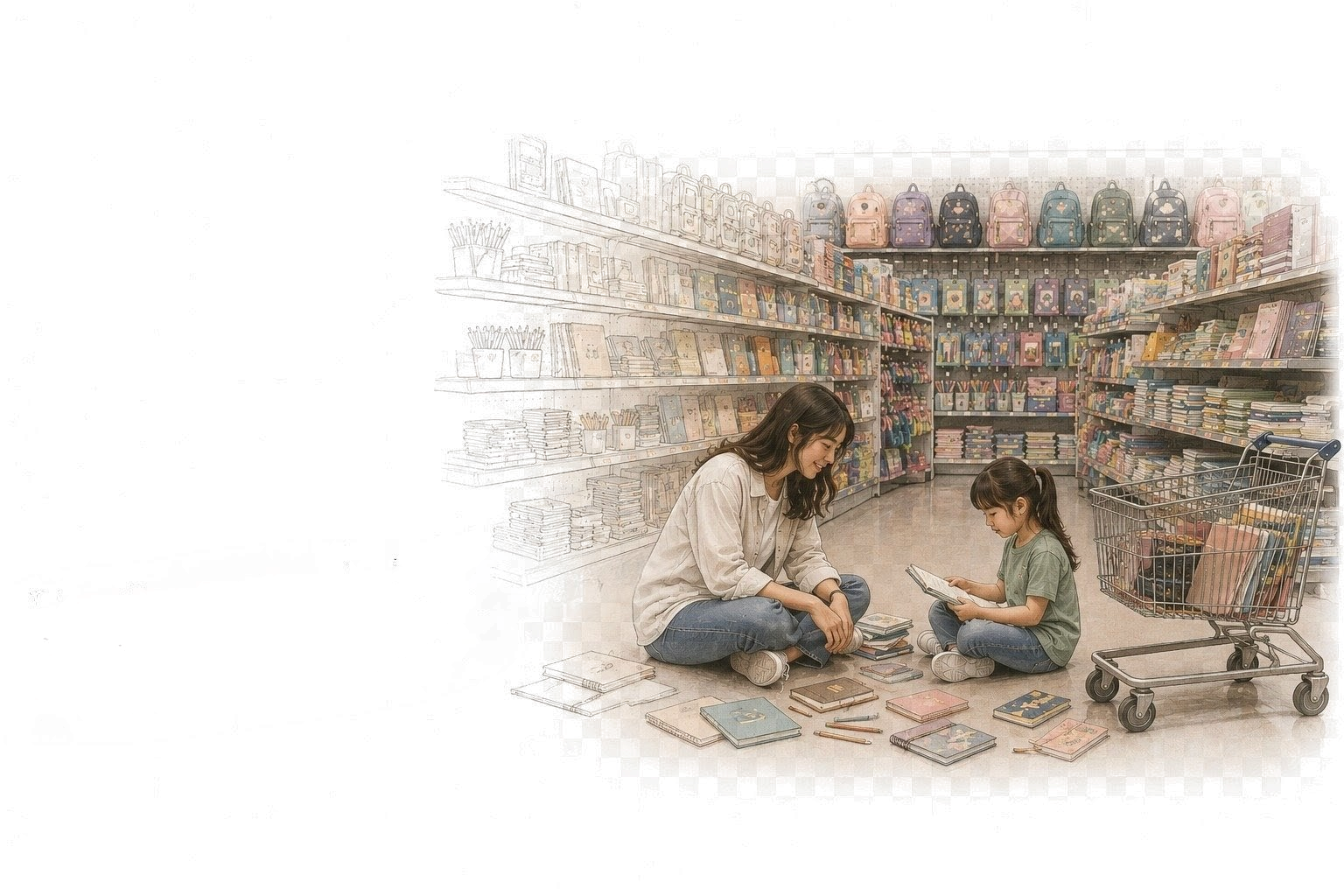
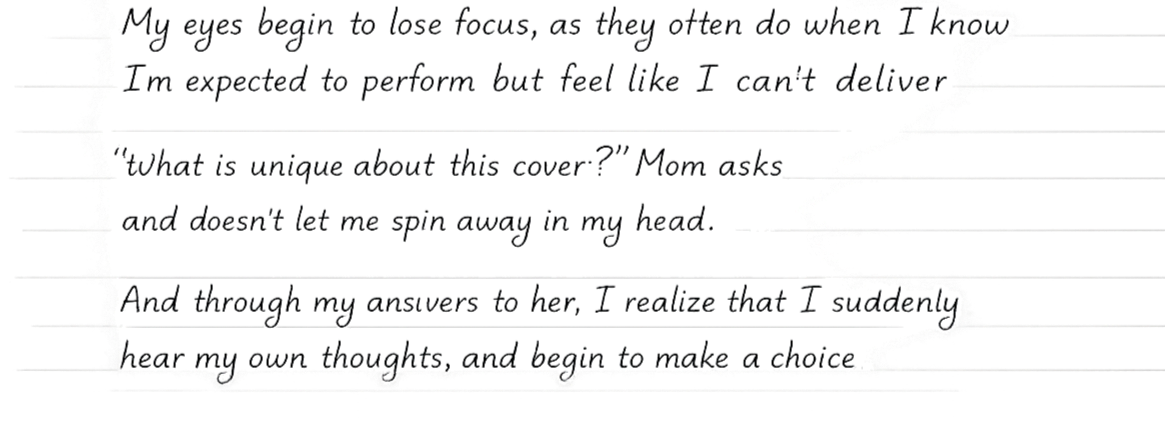
First piece. I am drawn inside. I am six years old again, sitting by Mom on the floor of a school supplies store. We spend hours sitting in our jeans, sorting the products, discussing and comparing their pros and cons, learning the wonders of questioning, the layers of choosing. This short story warms me up from inside. It has no connection to the original topic I wanted to explore in this seminar, but it feels good to immerse within the innocence and safe feeling in this memory with Mom. I later emailed her that piece. She loved it. We got a second chance to relive it, to be together at the beginning again.
Second piece. More like a motivational essay about my choice to be guided by feelings as the force that moves the needle through my life’s turning points. My forehead wrinkles in doubt. This feels like a pep talk. A shallow attempt to claim control over the happenings in my life.
Third piece. I am transported into my childhood living room. I am sixteen, sitting on the sofa next to Mom. With a deep breath and the bravest voice I can find, I announce that I do not want to enlist in my mandatory military service in the Israeli Defense Forces. Mom’s eyes pop in shock, her face stretches with questioning, and her surprised voice throughout our following conversation is a mix of discomfort and unconditional caring support. Back on my San Diego sofa, my hands drawn to wrap my chest and arms, my legs pulled into the center of my body, unknowingly mimicking the doubt and vulnerability that surfaced through this scene. Another text with no connection to my original topic. I frustratedly think when a hint of a smile softens my face as I also absorb the assurance and care in this open conversation with Mom.
And OMG. Suddenly, seeing them piece by piece on a page, I realize what is happening to me in this seminar. Out of the blue, by allowing myself to immerse in the autoethnographic practice, I received a second chance to be the child whose mother is not fighting a deadly illness somewhere far away, but is here, fighting and growing with me, by my side, through the potholes of life. My subconscious took this opportunity and did whatever it could to keep my mother in the present through my own stories. And even after writing three pieces, I was still blind to see it.
It was the fourth piece that made me realize this mess. I dive into it, and I am nineteen, re-living the deep depression I suffered through the first year of my military service after bending to social pressure, changing my mind, and enlisting at the very last second. I am fragile, lonely, and fearful, longing to be cured of what seemed like an unchangeable situation. It feels like now, like Mom’s condition. This text, which I wrote without knowing why, brought me back into the depth of a silenced, existentially threatening, unbearable pain, so overwhelming that I will also have to face what I try to conceal under the hecticness of my present: a similar pain, from the thought of losing Mom before she is even gone.
My eyes are wide in horror and astonishment. My breath is fast and shallow. My body is frozen in shock. Slowly, very slowly, I take my eyes off the screen and up toward the wall in front of me. As if to validate that there are parts of me that I still control, unlike my story-telling consciousness. I feel conned. This excruciating thought of losing Mom before she is gone is so unfamiliar to me, and yet, I suddenly realize it is also known to every fiber in my body. It is not a stranger understanding, but its presence in my knowing is simultaneously utterly foreign. As the revelations sink in, I glare, amazed at my computer screen. Touché autoethnography, you made it so easy to drift away mindlessly into the opportunity to reveal, to expose. To perform as the site of a collision between a hectic reality, incomprehensible mental storm, and vulnerability-demanding research method. Being authentically vulnerable, my now-retrospecting self realizes, is also what it takes to discover my grieving self.
***
Hirshhoren Lavie, L., (2025). There Is Such a Thing as Grief Before Loss: An Autoethnographic Exploration of a Two-Year Experience of Anticipatory Grief. Journal of Autoethnography, 6(4), 536–553. https://doi.org/10.1525/joae.2025.6.4.536
-
I am juggling the overload—my baby’s routine, breastfeeding day and night, our new rented home in this unfamiliar state that is still filled with boxes and mess, grad seminars and other academic projects. The fact that all of my family lives ten hours ahead of me in Israel while I am living in the US, feels like a million years away. And my mom, who is being eaten by the f***ing cancer, day after day, far away from me.
But more is happening. I keep my eyes closed for a few more moments of blissed shout-eyed darkness. I am just a graduate student who wanted to explore her interest in socially responsible consumerism through autoethnographic writing. But after half a semester in, the only thing clear about my seminar writing is that it has nothing to do with socially responsible consumerism. I have zero understanding of what my writings are really about, what story they tell, and why. I shared them with classmates and submitted them for professor evaluations—but no input revealed to me why this is what I write when I want to explore something else.
My body feels heated, angrily resisting this unfamiliar loss of control to an unwanted secret narrator that stirred me to revisit and expose stories-histories-emotions that I did - not intend to. I feel internally invaded. I cannot continue to be dragged like that from week to week, with every writing assignment unintentionally exposing another part of my childhood with no connection to what I AIMED to reveal. Don’t want to keep being a channel for embodied-painful moments from my past that I did not want to share. NO.
I open my eyes. Blurred, tired, but determined to mold words to caption what is happening in this out-of-control little corner in my life that continuously and independently shakes, dissects, and exposes me. Shhh. Quiet now, everything! It’s time to figure out this autoethnographic mess, analyzing one writing at a time.
First piece. I am drawn inside. I am six years old again, sitting by Mom on the floor of a school supplies store. We spend hours sitting in our jeans, sorting the products, discussing and comparing their pros and cons, learning the wonders of questioning, the layers of choosing. This short story warms me up from inside. It has no connection to the original topic I wanted to explore in this seminar, but it feels good to immerse within the innocence and safe feeling in this memory with Mom. I later emailed her that piece. She loved it. We got a second chance to relive it, to be together at the beginning again.
Second piece. More like a motivational essay about my choice to be guided by feelings as the force that moves the needle through my life’s turning points. My forehead wrinkles in doubt. This feels like a pep talk. A shallow attempt to claim control over the happenings in my life.
Third piece. I am transported into my childhood living room. I am sixteen, sitting on the sofa next to Mom. With a deep breath and the bravest voice I can find, I announce that I do not want to enlist in my mandatory military service in the Israeli Defense Forces. Mom’s eyes pop in shock, her face stretches with questioning, and her surprised voice throughout our following conversation is a mix of discomfort and unconditional caring support. Back on my San Diego sofa, my hands drawn to wrap my chest and arms, my legs pulled into the center of my body, unknowingly mimicking the doubt and vulnerability that surfaced through this scene. Another text with no connection to my original topic. I frustratedly think when a hint of a smile softens my face as I also absorb the assurance and care in this open conversation with Mom.
And OMG. Suddenly, seeing them piece by piece on a page, I realize what is happening to me in this seminar. Out of the blue, by allowing myself to immerse in the autoethnographic practice, I received a second chance to be the child whose mother is not fighting a deadly illness somewhere far away, but is here, fighting and growing with me, by my side, through the potholes of life. My subconscious took this opportunity and did whatever it could to keep my mother in the present through my own stories. And even after writing three pieces, I was still blind to see it.
It was the fourth piece that made me realize this mess. I dive into it, and I am nineteen, re-living the deep depression I suffered through the first year of my military service after bending to social pressure, changing my mind, and enlisting at the very last second. I am fragile, lonely, and fearful, longing to be cured of what seemed like an unchangeable situation. It feels like now, like Mom’s condition. This text, which I wrote without knowing why, brought me back into the depth of a silenced, existentially threatening, unbearable pain, so overwhelming that I will also have to face what I try to conceal under the hecticness of my present: a similar pain, from the thought of losing Mom before she is even gone.
My eyes are wide in horror and astonishment. My breath is fast and shallow. My body is frozen in shock. Slowly, very slowly, I take my eyes off the screen and up toward the wall in front of me. As if to validate that there are parts of me that I still control, unlike my story-telling consciousness. I feel conned. This excruciating thought of losing Mom before she is gone is so unfamiliar to me, and yet, I suddenly realize it is also known to every fiber in my body. It is not a stranger understanding, but its presence in my knowing is simultaneously utterly foreign. As the revelations sink in, I glare, amazed at my computer screen. Touché autoethnography, you made it so easy to drift away mindlessly into the opportunity to reveal, to expose. To perform as the site of a collision between a hectic reality, incomprehensible mental storm, and vulnerability-demanding research method. Being authentically vulnerable, my now-retrospecting self realizes, is also what it takes to discover my grieving self.
***
Hirshhoren Lavie, L., (2025). There Is Such a Thing as Grief Before Loss: An Autoethnographic Exploration of a Two-Year Experience of Anticipatory Grief. Journal of Autoethnography, 6(4), 536–553. https://doi.org/10.1525/joae.2025.6.4.536
What this work offers

✧ A space that is entirely yours — to slow down, attune to your own stories, and explore your experiences through writing.
✧Editorial guidance that helps you deepen, expand, and strengthen your writing while remaining true to your voice.
✧ An opportunity to discover what your experiences hold and find language for what matters most.
✧ A written record of important moments in your journey — the story of your lived experiences, told in your own voice, with depth and clarity.
We begin with a free 20-minute conversation
To understand where you are in your writing, what you need, and how we might begin to explore it together.