Write into the deeper layers of your lived experience
Work with your own writing - either from scratch or from an existing draft - to explore and deepen your personal narrative in a focused, one-on-one writing process.

The Work
You have a story you're living inside — a loss, a transition, a becoming. Maybe you've already started writing it. Maybe it exists only in fragments, in journal entries, in text notes on your phone, in the thing you keep almost saying out loud.
Here, you will give words to your story and trace yourself through your own experience.
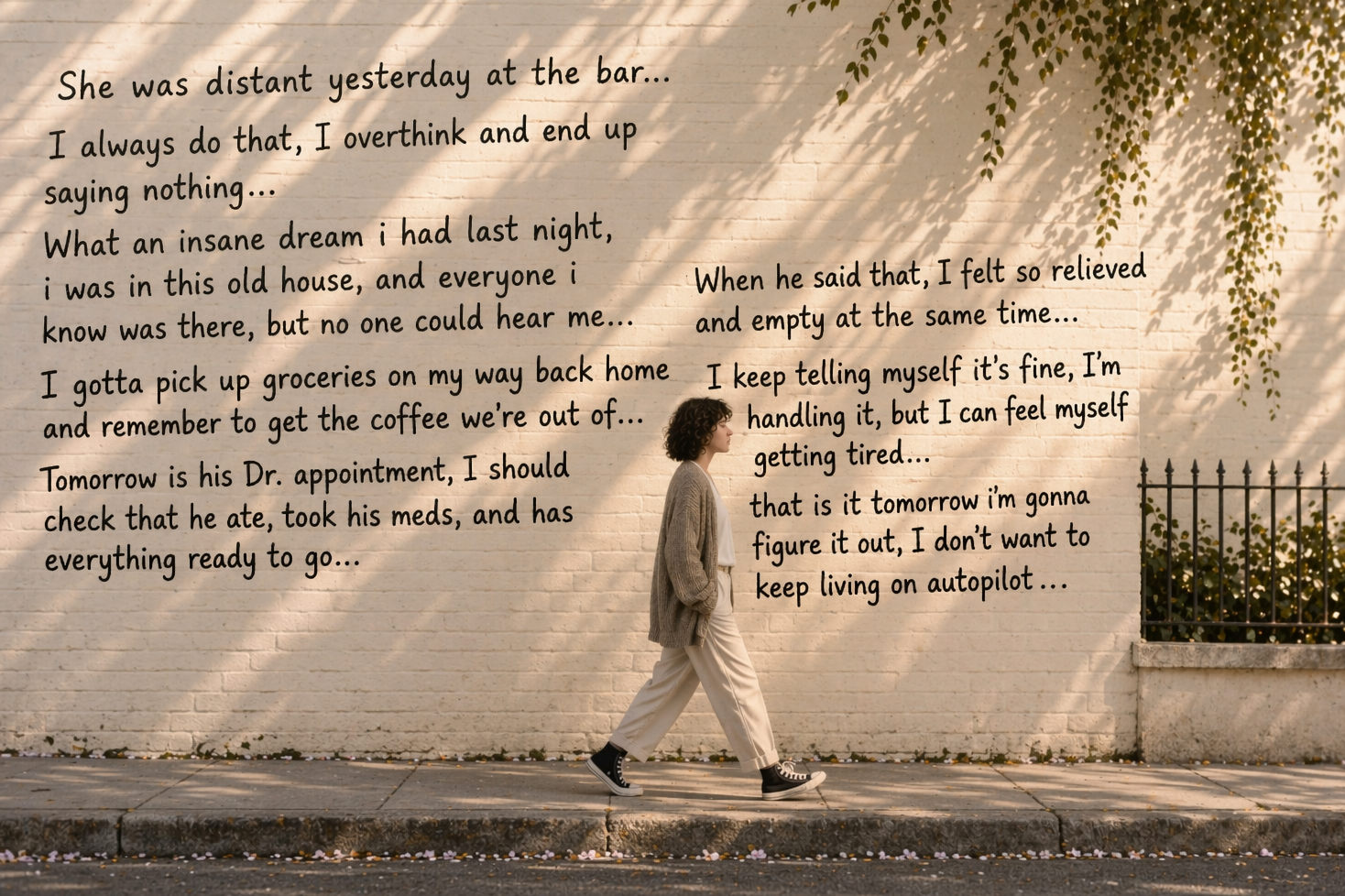
This is a one-on-one writing process built around your narrative.
We work with personal writing — essays, reflections, stories from your life — to help you go deeper into what you are already experiencing but haven't yet fully articulated.
Through close reading, detailed editorial response, deep questions, and focused conversation, we excavate what's underneath the surface of your story and find the language that fits it.
You bring your lived stories. I bring the lens and tools to help you write into them. We create the space your experience deserves.

Worth knowing
✦ This work lives alongside therapy, not inside it. We work with writing, not with psychological treatment. If your process brings up things that need therapeutic support, I will say so — and I can help you find it.
✦ Your voice stays yours throughout. I don't write for you — I help you write more deeply as yourself.
✦ You don't need writing experience or credentials to be here. There are no lectures, no craft lessons, no grades. The focus is your story and the goal is acknowledging its many edges and telling it fully.
The Process
We start with a free 20-minute conversation to understand where you are, what you're working with, and what you need. From there, the process takes one of two shapes:


-
After our free 20-minute conversation, you send me your writing.
I read it closely — with attention to what is present, what is emerging, and what might still be held back. I return it to you with detailed comments and questions.
Then we meet for a first 1-hour session to go deeper.
We stay with what the text is reaching for, what it's avoiding, and where it might want to go. The session is a space for dialogue: we go beyond the written notes, explore what surfaces in conversation, and follow the questions that are now ready to be asked out loud.
You then return to your writing with the insights — revising, deepening, and extending the work. I read the new version, and we meet again for a second 1-hour session.
Allow at least two sessions per written piece. For longer pieces (5+ pages), allow at least three.
﹡Sessions are held online or in person in Seattle, Washington.﹡My process is deeply individual — I tailor it to each client's needs, preferences, and goals.
-
After our free 20-minute conversation, I will send you a curated list of writing prompts and a short written guide to help you begin.
You write 2–3 pieces and send them to me.
I read them closely, write detailed comments and questions, and return them to you.
Then we meet for a first 1-hour session to go deeper.
We stay with what your writing is reaching for, what it's circling around, and what wants to be said more fully. The session is a space for rich dialogue: we go beyond the written notes, explore what surfaces in conversation, and follow the questions that are now ready to be asked out loud.
You then return to your writing with these insights — revising, deepening, reaching further. I read the new versions, and we meet again for a second 1-hour session.
Allow at least two sessions per written piece.
﹡Sessions are held online or in person in Seattle, Washington.﹡My process is deeply individual — I tailor it to each client's needs, preferences, and goals.


Your story is already living within you — your words just need the space we will invent for them together.
I wrote my way into understanding my own grief experience before I had words for it. That's the nature of this work — the writing reveals what you're living through.
Your story is welcome here, even if you don't yet know what it's about. Especially then.

What this work gives you
A space that is entirely yours — to explore, to slow down, to be authentic.
A deeper understanding of your own experience, and words for it that finally fit.
A written, edited record of important moments in your journey — your story, told in your own voice, with depth and clarity.
Let's put your self on a page.
My Story
I didn't know I was grieving until I started writing.
For two years, I lived through my mother's fight and loss to cancer — through COVID, through my first pregnancy and birth, while becoming a mother to my son, moving between states, pursuing a MA degree, all while living half a world away from my mom and my entire family. So much was happening. I was juggling, trying to keep all the balls in the air, but the ground beneath my feet was shaking, crumbling. Loss was coming. And I could not see it, could not comprehend its path, could not acknowledge that its impact was already rifting through my identity and body. I didn't have words for what was happening inside me, because the words I needed were not part of anything I knew. I didn't know that there is such a thing as grief before the loss. To me, grief was constructed as a phase that comes after the loss. Not before. Not during. I was detached from my own experience.
Writing changed that. I was a graduate student practicing autoethnography — personal narrative writing that uses personal experience as a lens into social phenomena — when my own writing started pulling me somewhere I hadn't planned to go. Story by story, I found myself portraying more moments from my past with my mom. My subconscious was doing what I couldn't, through my writing: keeping her present, unleashing my first expression of my anticipatory grief, helping me surface and acknowledge the thought of losing Mom before she is even gone - my experience of Mom’s dying, which was invisible and irrelevant to me until then.
My writing invented space for my grief experience to be revealed and language to articulate it.
That experience became the foundation of my MA in Communication Studies thesis and my published article in the Journal of Autoethnography. Personal narrative writing has become the practice through which I deeply explore other layers of my journey, such as years of experience building a life in a language I was not born with, relocating and leaving everything familiar behind, and learning to be intentional about belonging. Raising my children to know family as a generational journey of multicultural roots, while our family tree spans over continents. My personal story is what led me to this practice. I learned, from the inside, what writing can do for a person living through something they don't yet have words for, but who has the courage to be authentically vulnerable on the page to discover it.
I am not a therapist. I am a researcher, a writer, and someone who has been where the writing goes.
"Those who choose this vulnerable methodological path to process their grief experiences will revisit their altering self through their writings across time, distance, and learning... They will reveal the journey they were forced to walk through. Carve words for their experience and see their grieving selves emerge, evolve, become." — from "There Is Such a Thing as Grief Before Loss," Journal of Autoethnography, 2025
Begin with a free 20-minute conversation
A first conversation to understand where you are in your writing, what you need, and how we might begin to explore it together.